Push monitors for services we can't probe from outside.
Your service POSTs results to us with auth. Perfect for monitors inside a VPC, behind a firewall, or anywhere a public probe can't reach.
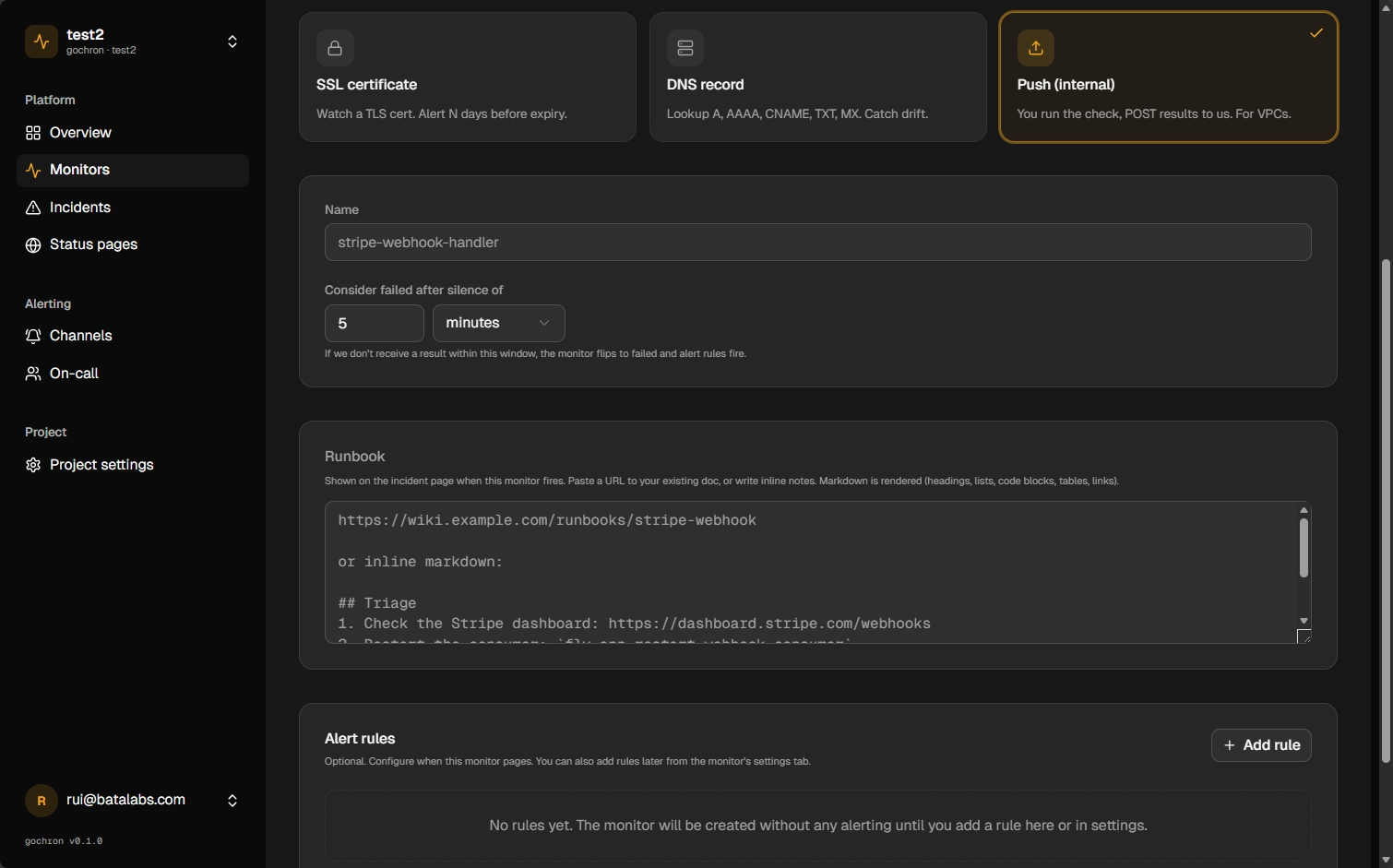
When this monitor earns its keep.
Three concrete patterns. Use them as templates for your own setup.
Air-gapped infrastructure
A worker fleet inside a private subnet with no public ingress. The fleet itself POSTs 'I'm healthy' every minute. Silence = paged.
Service-internal health
Queue depth above 10k? POST fail. Below? POST pass. Thresholds only your service can see, routed through the same alert rules and rotations as any other monitor.
Synthetic transaction loops
Run a multi-step test (login → fetch → checkout) from your CI fleet on a cron. POST pass/fail to gochron. Aggregate alerts + rotations + status pages without rolling your own.
How the setup looks.
Your service POSTs results on a schedule. Silence opens an incident. Flat rate per monitor; push cadence and alert channels do not change the bill.
Same auth, same alert rules, same status pages as every other monitor type. See all 6
Create a push monitor
Copy the push URL and bearer token from the dashboard. Rotate tokens per monitor.
POST on your cadence
Send pass/fail, latency, and optional labels from inside your VPC or batch job.
Set silent-after
If pushes stop, we page using the same rotations and status pages as probe monitors.
FAQ
- Why use push instead of HTTP probes?
- When your service can't be reached from our prober regions. Inside a VPC, behind a customer firewall, or for service-internal signals (queue depth, etc.).
- How is auth handled?
- The slug in the URL is the credential — same model as the cron ping endpoint. Each monitor gets its own random 12-character slug shown on the dashboard. POST to /api/push/<slug>/results with a JSON body; no Authorization header required. Rotate the slug from the dashboard if it leaks.
- What if my service crashes between pushes?
- The silent-after window catches it. If you push every 60s and silent-after is 90s, a crash opens an incident within 90 seconds of the missed push.